
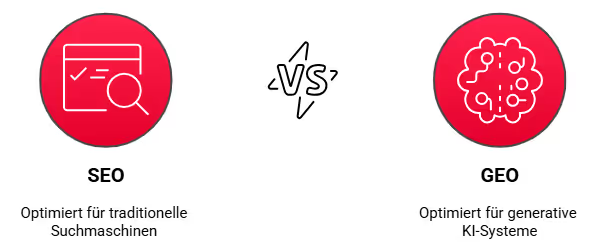
Generative Engine Optimization (GEO) is a modern method of increasing digital visibility that focuses on optimization for generative AI systems such as ChatGPT, Perplexity or Google AI Overview (formerly SGE Search Generative Experience). In contrast to classic search engine optimization (SEO), which is based on the algorithms of traditional search engines such as Google, GEO aims to answer user questions through generative engines.
These engines not only search websites, but also use AI models to summarize content in a contextual way. And this is exactly where AI systems trump search engines such as Google and Co. For long or complicated search queries (long-tail), search engines can barely provide context-based answers. As a result, search engines have increasingly tried to justify their poor search results in recent years (Example from SEJ, Example in SEL).
Anyone who is not visible in “new search systems” such as ChatGPT Search, Gemini or Perplexity loses reach. GEO is therefore an important part of modern marketing strategies. This is particularly true in a market that is increasingly characterized by artificial intelligence.
Hurra.com has been a pioneer in data-driven performance marketing and SEO services for over two decades. We use our own technologies for, for example, AI-based campaign optimization and real-time bidding processes.
Important information about Generative Engine Optimization (GEO)
- GEO is a new concept for optimising digital content, which is intended to improve visibility in responses from AI-driven generative engines (GEs). This technology combines information from various sources to answer user queries.
- GEO optimizes content. It improves quality, relevance, and clarity. It also provides a natural, conversational tone that meets the requirements of AI models.
- GEO can increase content visibility in generative engine responses by up to 40%. (spring)
- The effectiveness of GEO strategies varies depending on the subject area and type of request
How does Generative Engine Optimization (GEO) work?
GEO is a new method. It helps to design content in such a way that artificial intelligence (AI) understands it better. This is different from classic search engine optimization (SEO). SEO focuses heavily on keywords and backlinks.
Here's a quick overview of how GEO works:
- Make AI better understood: GEO ensures that the content of AI models is correctly understood. It is not just about keywords, but about the context, the brand and the overall content.
- Without exact knowledge of algorithms: GEO works like a “black box.” That means you don't have to know exactly how the AI algorithm works — you can still specifically adapt content to become more visible.
- Optimize content: GEO uses various methods to improve texts — for example through clear language, convincing tonality, good structure, or the incorporation of quotations and numbers. Old SEO tricks such as keyword stuffing are of little use here.
- Measure visibility: GEO uses its own metrics for visibility — how often and how prominently content appears in AI responses. This visibility is often more important than ranking in a classic list of results.
- Different depending on the topic: The best GEO strategies depend on the topic. References, for example, help with facts. For opinions, a clear, strong style is better.
- Advantage for smaller sites: Websites that end up further down in Google search can also benefit greatly from GEO in AI answers. In addition to content, AI also evaluates other metrics that are important for the “relevant set” of AI. Who is relevant is played out.
- Constantly adapting: GEO is not a one-time step, but a process. As AI technologies are constantly evolving, testing and readjustment must be carried out continuously.
Differences between SEO, GEO and GAIO
Search engine optimization (SEO), generative engine optimization (GEO) and generative AI optimization (GAIO) are related but different areas. SEO improves a website's visibility in traditional search results. GEO optimizes content so that AI search engines can answer questions directly. GAIO goes even further and optimizes for generative AI applications. This means that content is created in such a way that AI systems can understand it and use it to create new content.
Benefits of GEO
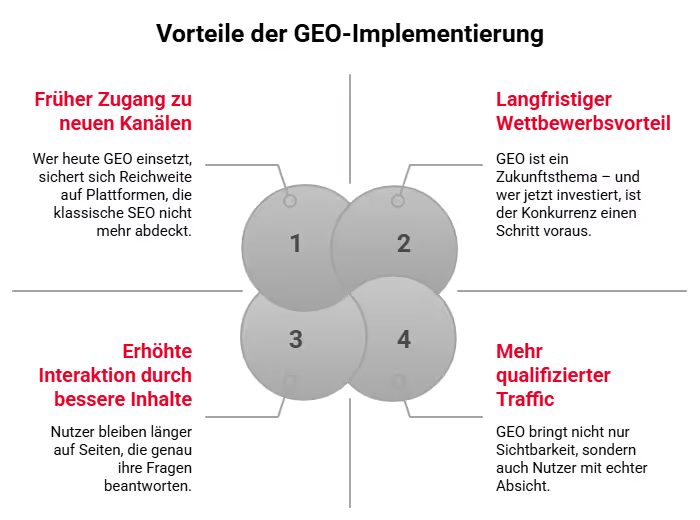
The integration of Generative Engine Optimization (GEO) offers a wide range of benefits — not only in terms of visibility, but also for brand building and user loyalty:
Areas of application of GEO
Generative Engine Optimization (GEO) is a new concept. It is intended to increase the visibility of content in answers from AI-driven search engines. The main areas of application of GEO include:
- Content creator: GEO provides a creator-friendly framework. It helps to optimize web content and increase visibility in generative search responses. The goal is to give content creators more control. They can decide when and how their content is displayed in this new search environment.
- Website operator: GEO is an optimization framework for website operators. It helps improve websites for generative engines. Operators adjust the presentation, writing style, and content. In this way, they increase the chance that their content will be cited and highlighted.
- Companies and brands: GEO is a digital strategy that helps companies and brands to be successful in the age of generative engines. It ensures that the brand message is correctly and effectively presented and disseminated in AI-generated responses, which ultimately leads to more brand recognition, website visits, and offline engagement.
GEO is important for anyone who creates content online. It helps that this content is recognized and cited by artificial intelligence. The goal is to incorporate valuable and authoritative content into the answers provided by the generative engines.
Best practices and techniques for successful GEO implementation
GEO (Generative Engine Optimization) is a modern way of designing content so that it appears in AI-generated answers (e.g. from ChatGPT, Perplexity, or Google AI Overviews). In contrast to classic SEO, GEO is not just about good rankings on Google, but also about being best answer to be selected in generative systems.
Here are the key tips and best practices for a successful GEO strategy:
1. Not all GEO is the same as SEO
SEO wants to be at the top of Google. GEO wants to be played out by AI as a suitable answer. Clarity, context and natural language count more than many keywords. Too many catchphrases are of little use. An investigation found that Measures such as citations, statistics, and source citations can increase visibility by 30-40%.
2. Write high-quality content
AI prefers content that answers a question directly, is technically correct and offers real added value. Write clearly, comprehensibly, and as people would actually ask.
3. Use natural language
Use questions as headlines and answer them directly in the text. Longer search phrases (“long-tail keywords”) and natural phrases help to be recognized by AI.
4. Use more than just text
Combine text with images or videos. While diversity alone doesn't guarantee that your content appears more often, it can improve the user experience.
5. Quality over quantity
The AI is looking for the best answer — not the longest. Work with clear structures: Subheadings, lists and short paragraphs help the AI understand.
6. Implement everything cleanly from a technical perspective
Make sure that your site works well technically:
- structured data (schema.org)
- Quick load times
- Mobile optimization
- accessibility
Important: AI crawlers such as GptBot, CloudVertexBot, ClaudeBot, DeepSeekBot, Apple-Extended should have access to the website.
7. Build trust
When your brand is reliable, the chance of showing up in AI answers increases. Make sure that content is consistent across all channels and build good backlinks in a targeted manner.
8. Use quotes, sources, and figures
Quotes, statistics, and sources increase the visibility of your content. Even small additions, such as a suitable quote or statistics, can bring significantly more reach.
This can be particularly helpful for less heavily ranked pages: A website in 5th place was able to increase its visibility by over 115% (spring)
9. Understanding user intent
Not every search is the same. Some want information, others want to make a purchase, or find a specific website. Adapt your content to that.
10. Write clearly and comprehensibly
Avoid complicated jargon if it isn't necessary. Content that is written fluently and error-free is better recognized — and used more frequently.
11. Adapt content to the industry
Depending on the topic, other GEO tactics are useful. Technical terms help in technical topics; in cultural topics, quotes or personal statements tend to help. Adjust your style
12. Distribute content in a targeted manner
Share your content on platforms like Quora or Reddit. Use reviews, comments, and other user-generated content to get more reach.
13. Measure and adapt continuously
Watch how much traffic is coming from AI platforms. Use analytics tools to see which content is working well—and improve your strategy regularly.
14. Sites with weak SEO rankings can also benefit
GEO can be a real boost, especially for pages that are not at the top of Google. In some cases, GEO more than doubled the visibility of such pages — while top pages were even shown less frequently.
GEO is a modern addition to classic SEO. With clear, helpful content, technical cleanliness, and a good understanding of how AI systems work, your website can be visible and successful even in the new world of generative answers.
Start now with AI monitoring and see where your brand appears in ChatGPT & Co.
Our AI monitoring combines the best technological setup currently available on the market.
→ questions Thomas Nething, our Director of Business Innovations, will be happy to answer your questions about AI monitoring.
Tools for GEO
Optimization for generative search systems can be supported by a combination of traditional SEO tools and AI-specific analysis tools. Here are key tools and approaches:
1. AI-powered content optimization
- Frase: Assists in the creation of content-relevant texts by analyzing and answering frequently asked questions.
- Surfer SEO: Combines classic SEO data with AI recommendations on structure, keyword usage, and text length.
2. AI Search Grader
- HubSpot AI Search Grader: Evaluates content with regard to its suitability for AI search systems and provides suggestions for optimization in terms of structure, relevance and quality.
3. Rank tracking for generative content
- Some SEO tools start by recording visibility in Google AI overviews and AI citations — a step towards evaluating GEO performance.
4. Monitoring AI mentions
- Seer Interactive Tools: Enable tracking of brand mentions in ChatGPT, Gemini and Google AI overviews, including competitive comparisons and traffic analyses (partly in cooperation with Ziptie.dev).
5. Analytics integration
- Platforms such as Google Analytics 4 can be adapted to collect data from generative AI platforms (e.g. ChatGPT, Perplexity) and make their contribution to conversions and traffic visible.
6. Analyzing AI responses
- Investigating topics, answer structure, and sources in AI answers helps to better understand which content is preferred to process and cite.
7. Keyword and topic research
Tools for Keyword research remain useful, particularly for identifying long-tail questions, entities, semantics, and natural search phrases that are also relevant to generative engines.
Challenges when implementing GEO
Despite all opportunities, the introduction of GEO also poses some challenges. One of the biggest is the lack of clear standards. Since generative search engines have only recently been used, there are no uniform guidelines as with classic SEO. Companies must therefore often experiment and react flexibly to new developments.
Another obstacle lies in understanding how AI models and their LLM's (Large Language Models) work. Many marketing departments find it difficult to understand the logic behind generative systems — particularly because they do not use fixed ranking factors but work in a context-related manner. GEO therefore requires interdisciplinary know-how from editing, technology and data analysis.
In addition, uncertainty can arise when content suddenly stops appearing or is replaced by competing sources. Transparency is often lacking — and that makes monitoring and readjustment all the more important.
Hurra.com scores points here with a deep understanding of AI, clear workflows and well-founded advice on the introduction of GEO in companies in various industries.
Future developments in the area of GEO
GEO is only just getting started — but it is already becoming apparent that the technology will change information behavior in the long term. In the future, generative search systems will be integrated even more into everyday applications — such as operating systems, voice assistants or business software. GEO will thus not only be an SEO upgrade, but also a central element in digital communication.
Another trend is the greater personalization of generative responses. Content must no longer only be generally correct, but also fit the user's individual contexts. GEO strategies of the future must therefore be tailored even more precisely to personas in order to deliver personalized and relevant content while remaining trustworthy.
Legal and ethical issues are also becoming more relevant. Companies must clarify how they handle sources, what data they disclose, and how they make content available for AI without losing control of their brand. In the future, GEO will be more than just a content strategy — it will become part of digital brand management, communication and user interaction.
Conclusion
Generative Engine Optimization (GEO) is more than a short-term hype — it is a strategic approach for the future of digital visibility. Anyone who understands how generative AI selects and presents content or brands can have a targeted influence on this. It is not just technology or keywords that matter, but above all quality, relevance and structure.
GEO provides companies with new opportunities to be visible in the answers of the next generation of search systems — right where decisions are made. With the right combination of technology, content and strategy, this visibility can be built up sustainably.
Hurra Communications offers the right expertise to successfully integrate GEO into existing marketing and content processes. This is how generative technology becomes a real competitive advantage — intelligent, human and future-proof.