
In the complex world of SEO, sitemaps are often dismissed as a mere technical byproduct. However, a data-driven approach quickly reveals that they are far more than just a list of URLs. Instead, a sitemap acts as the strategic blueprint provided to Google’s crawlers to massively boost indexing efficiency. For large enterprise portals in particular, sitemap quality dictates whether high-value content surface promptly in search results or gets lost in the digital archive.
HTML Sitemaps: A Shift in Perspective
Historically, offering an HTML sitemap as a user-facing table of contents was standard practice. Today, however, this often compromises the User Experience (UX). Presenting thousands of URLs in a flat list feels cluttered and uninviting to visitors. From a technical standpoint, these setups are rarely executed cleanly and tend to bloat the site's navigation.
That is why modern SEO strategies rely primarily on XML sitemaps engineered exclusively for search engine bots. User guidance is instead handled through intuitive menu structures and internal linking. This holistic approach is a core component of modern Search Synergies, perfectly balancing technical requirements with user needs.
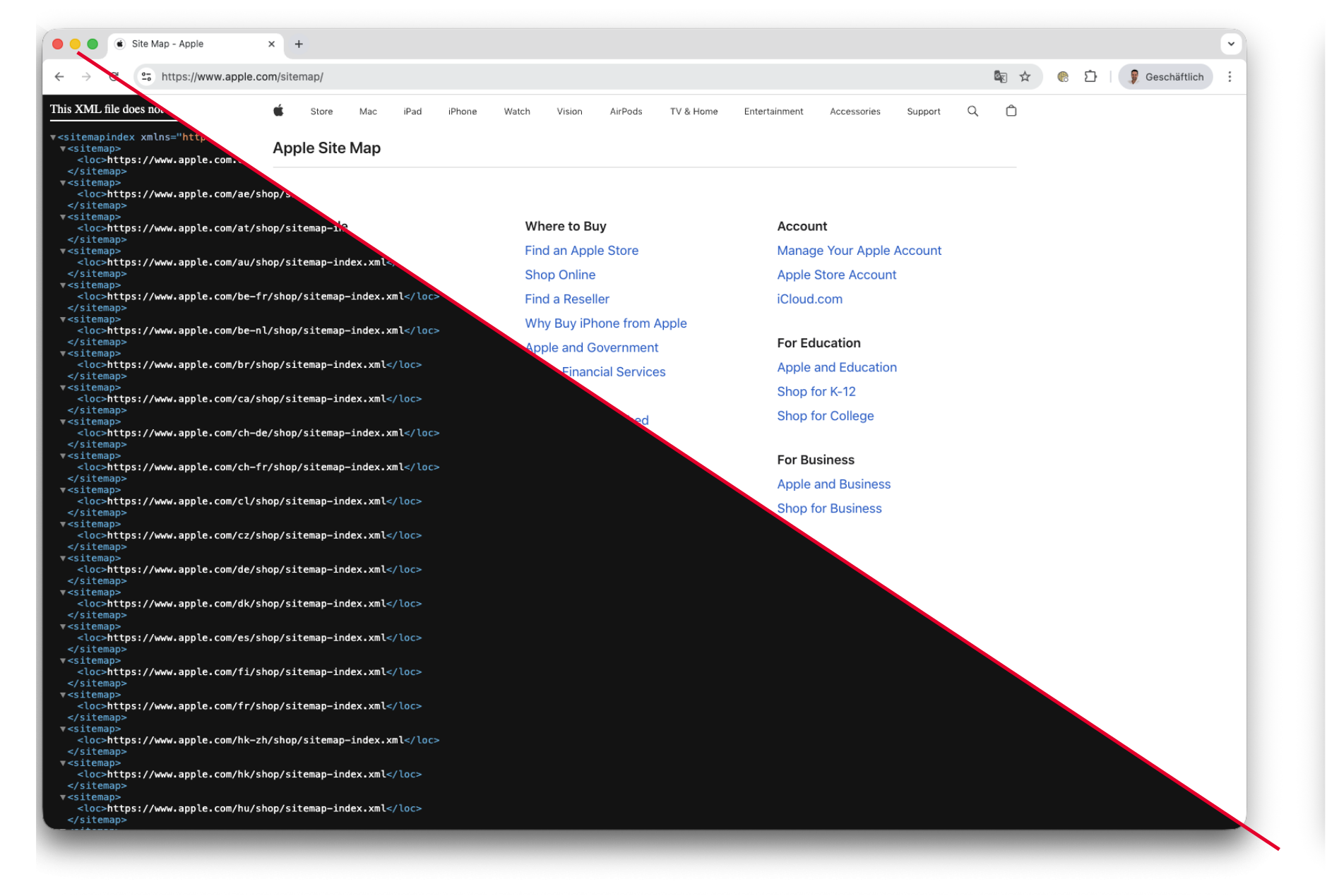
Why Sitemaps are Essential for Modern SEO
Search engines and AI models operate with finite resources. The crawl budget, which is the time and computing power a bot allocates to a specific domain, is strictly limited.
Efficient Crawl Budget Management
A precise sitemap guides crawlers directly to the pages that drive business success. Instead of wasting valuable resources on outdated or irrelevant pages, it ensures search bots prioritize the most profitable areas of your domain.
Accelerated Indexing for Dynamic Content
For news portals or ecommerce platforms with fast moving inventories, speed is a major competitive advantage. A dynamically generated sitemap instantly signals to Google when new URLs are added, drastically shortening the gap between publication and your first organic impressions.
Formats and Technical Best Practices: Beyond Standard XML
While XML is the industry standard, Google supports multiple sitemap formats. Beyond traditional XML, a simple text file (.txt) can be used, requiring nothing more than one URL per line.
Limits and Scaling
Regardless of the format, strict boundaries apply. A single sitemap file cannot exceed 50,000 URLs or a file size of 50 MB uncompressed. These constraints apply equally to both XML and text formats. For large scale setups, multiple sitemaps must be managed via a Sitemap Index file, as detailed in the official Google Search Console Guidelines.
The Strategic Importance of the lastmod Tag
The <lastmod> attribute is a critical lever for crawl efficiency. It provides search engines with an exact timestamp of a URL’s last significant update.
- Precision Over Guesswork: Instead of blindly re-crawling every page, bots leverage
lastmoddata to determine if a recrawl is genuinely necessary. - The Freshness Signal: Accurately maintained
lastmoddata serves as a direct freshness signal, which is vital for time sensitive content.
Important: The timestamp must follow the W3C date format, such as YYYY-MM-DD. To maintain algorithmic trust, this tag should only be updated for substantial content changes because fake updates will quickly dilute its signaling effect.
<?xml version="1.0" encoding="UTF-8"?>
<urlset xmlns="http://www.sitemaps.org/schemas/sitemap/0.9">

    <url>
        <loc>https://www.hurra.com/de</loc>
        <lastmod>2026-03-24</lastmod>
    </url>

</urlset>
Internationalization: Mapping hreflang Logic via the Sitemap
The correct implementation of hreflang tags is often a major technical challenge for global enterprises. Instead of bloating the HTML header of every single page with dozens of language alternatives, the sitemap offers an elegant solution.
Using the xhtml:link attribute, you can store the complete internationalization logic directly within the XML sitemap. This significantly reduces page size and centralizes the management of your language targeting. As a result, Google instantly recognizes which language version is relevant for each user based on their region and language settings.
<?xml version="1.0" encoding="UTF-8"?>
<urlset xmlns="http://www.sitemaps.org/schemas/sitemap/0.9"
xmlns:xhtml="http://www.w3.org/1999/xhtml">

<url>
    <loc>https://www.hurra.com/de</loc>
    <xhtml:link rel="alternate" hreflang="de"
    href="https://www.hurra.com/de"/>
    <xhtml:link rel="alternate" hreflang="en"
    href="https://www.hurra.com/en"/>
    <xhtml:link rel="alternate" hreflang="x-default"
    href="https://www.hurra.com/en"/>
</url>

<url>
    <loc>https://www.hurra.com/en</loc>
    <xhtml:link rel="alternate" hreflang="de"
    href="https://www.hurra.com/de"/>
    <xhtml:link rel="alternate" hreflang="en"
    href="https://www.hurra.com/en"/>
    <xhtml:link rel="alternate" hreflang="x-default"
    href="https://www.hurra.com/en"/>
</url>

</urlset>
Pro Tip: If you map hreflang via your sitemap, you can often avoid additional caching overhead in the frontend. At the same time, your Time to First Byte can improve because the internationalization logic does not need to be processed with every page request.
Specialized Sitemaps: Image Sitemaps for Visual Search
In many industries, particularly ecommerce, Google Image Search generates significant traffic. Standard sitemaps often fail to capture images adequately, especially when they load via JavaScript galleries.
A dedicated image sitemap allows you to provide specific metadata to search engines:
- Image URL (
<image:loc>): The direct path to the image file. - Title and Caption: Additional context that helps power modern visual search and AI image recognition.
<?xml version="1.0" encoding="UTF-8"?>

<urlset
xmlns="http://www.sitemaps.org/schemas/sitemap/0.9"
xmlns:image="http://www.google.com/schemas/sitemap-image/1.1">

<url>
<loc>https://www.hurra.com/de</loc>

<!-- Bilder -->
<image:image>
<image:loc>https://www.hurra.com/images/de-beispiel-1.jpg</image:loc>
<image:title>Beispielbild 1 Deutsch</image:title>
</image:image>
<image:image>
<image:loc>https://www.hurra.com/images/de-beispiel-2.jpg</image:loc>
<image:title>Beispielbild 2 Deutsch</image:title>
</image:image>
</url>

</urlset>
Enterprise SEO: Nested Sitemaps and Index Files
When your web presence exceeds the 50,000 URL limit, the concept of sitemap nesting comes into play. This architecture involves creating a sitemap index file.
This index file acts as a central container. Instead of pointing directly to content pages, it links to further sub sitemaps. This hierarchical structure allows for virtually unlimited scalability:
- Structure: Sitemaps are grouped cleanly by category, such as
sitemap products 1.xmlorsitemap blog.xml. - Error Analysis: Within Google Search Console, you can isolate and analyze each individual sub sitemap to pinpoint exactly where indexing issues occur.
- Management: Large portals with millions of URLs often deploy hundreds of nested sitemaps to distribute the data load and maintain perfect clarity for crawlers.
<?xml version="1.0" encoding="UTF-8"?>
<sitemapindex xmlns="http://www.sitemaps.org/schemas/sitemap/0.9">

<sitemap>
<loc>https://www.hurra.com/sitemap-produkte.xml</loc>
<lastmod>2026-03-24</lastmod>
</sitemap>

<sitemap>
<loc>https://www.hurra.com/sitemap-blog.xml</loc>
<lastmod>2026-03-24</lastmod>
</sitemap>

<sitemap>
<loc>https://www.hurra.com/sitemap-seiten.xml</loc>
<lastmod>2026-03-24</lastmod>
</sitemap>

</sitemapindex>
Pro Tip: Additionally, it can be useful to create a separate sitemap containing only your most critical, high value URLs. This allows you to analyze them in isolation within Google Search Console, making it much faster to verify that your core pages are reliably crawled and indexed.
Hygiene Factors: What Does Not Belong in a Sitemap
A clean sitemap contains only URLs that are fully eligible for search results. This means you must exclude the following elements:
- Pages containing a noindex tag.
- URLs with status codes other than 200, such as 404 errors or 301 redirects.
- Non canonical URLs that point to alternative target pages.
- Directories currently blocked by your robots.txt file.
Integration and Monitoring: Search Console and robots.txt
There are two primary ways to make search engines aware of your sitemap. The direct method is through Google Search Console, where the sitemap URL is submitted manually so its status can be monitored over time.
However, there is another essential method, which is adding an entry directly into your robots.txt file. A simple line such as Sitemap: https://www.yourdomain.com/sitemap.xml signals to the crawler upon its very first visit where your strategic blueprint can be found. This is particularly helpful for search engines where you might not maintain an active webmaster tools account.
Conclusion: Sitemaps as Part of Your Marketing Intelligence Strategy
Sitemaps in SEO are not a one time project but rather a continuous process of quality assurance. In an era where AI powered crawlers are becoming increasingly efficient, providing a clean and up to date sitemap is the absolute foundation for any successful performance campaign.
Do you want to take the indexing of your complex web structure to the next level? Our experts can help you overcome technical hurdles and sustainably increase your organic visibility. Visit our Insider Magazine for more insights or schedule a consultation directly via our contact page.
FAQ: The 10 Most Important Questions About Sitemap SEO
What is an XML Sitemap?
An XML file that lists all relevant URLs of a website to facilitate efficient crawling by search engines.
Can I also use a text file as a sitemap?
Yes, Google accepts simple text files containing one URL per line, provided they do not exceed the 50,000 URL limit.
Why is an HTML sitemap often not ideal?
From a user experience perspective, a complete URL list often appears cluttered and offers little added value to visitors compared to an intuitive navigation structure.
When does a sitemap become truly important?
A sitemap is essential for managing your crawl budget, particularly for large scale sites containing more than 50,000 URLs.
What is the file size limit?
A sitemap can be a maximum of 50 MB uncompressed.
How do I integrate the sitemap, other than via Search Console?
The sitemap URL can be stored directly in your robots.txt file so that crawlers find it automatically upon visiting your site.
What is a Sitemap index file?
A parent file that points to multiple individual sub sitemaps to bypass the 50,000 URL limit.
Should redirects be included in the sitemap?
No, only URLs with a 200 status code that are intended for direct indexing should be included in the file.
What does the lastmod tag mean?
It indicates when a page was last modified, helping search engines determine whether a recrawl is genuinely necessary.
How often should the sitemap be updated?
Ideally, it should update automatically and in real time as soon as new content is published.