On March 26, 2026, I attended NextM in Düsseldorf, where the overarching theme was "Optimistic Transformation." But for me, the most exciting part of the conference wasn't the new technologies on display. Instead, it was how the event exposed a long-standing weakness in marketing. We constantly talk about tools, channels, and efficiency, but we rarely discuss how real impact is created.
That was my true takeaway from the day—not just as an observer at the conference, but as a confirmation of the exact discussions we are currently having at hurra.com.
Coming at it from completely different angles, several sessions pointed to this identical theme: Oona Horx-Strathern with her perspective on societal counter-trends; Roland Eisenbrand on the changing logic of platforms and distribution; Felipe Thomaz, Iris Althaus, and Stuart Bowden with their research on media effectiveness; and Samira El Ouassil on stories as repositories of meaning.
What these presentations crystallized for me can be condensed into a single sentence: The central challenge in marketing today is not a lack of technology.
Rather, it is an overly simplistic understanding of how impact is created, how visibility is distributed, and how decisions are made.
1. Counter-trends are often more important than trends
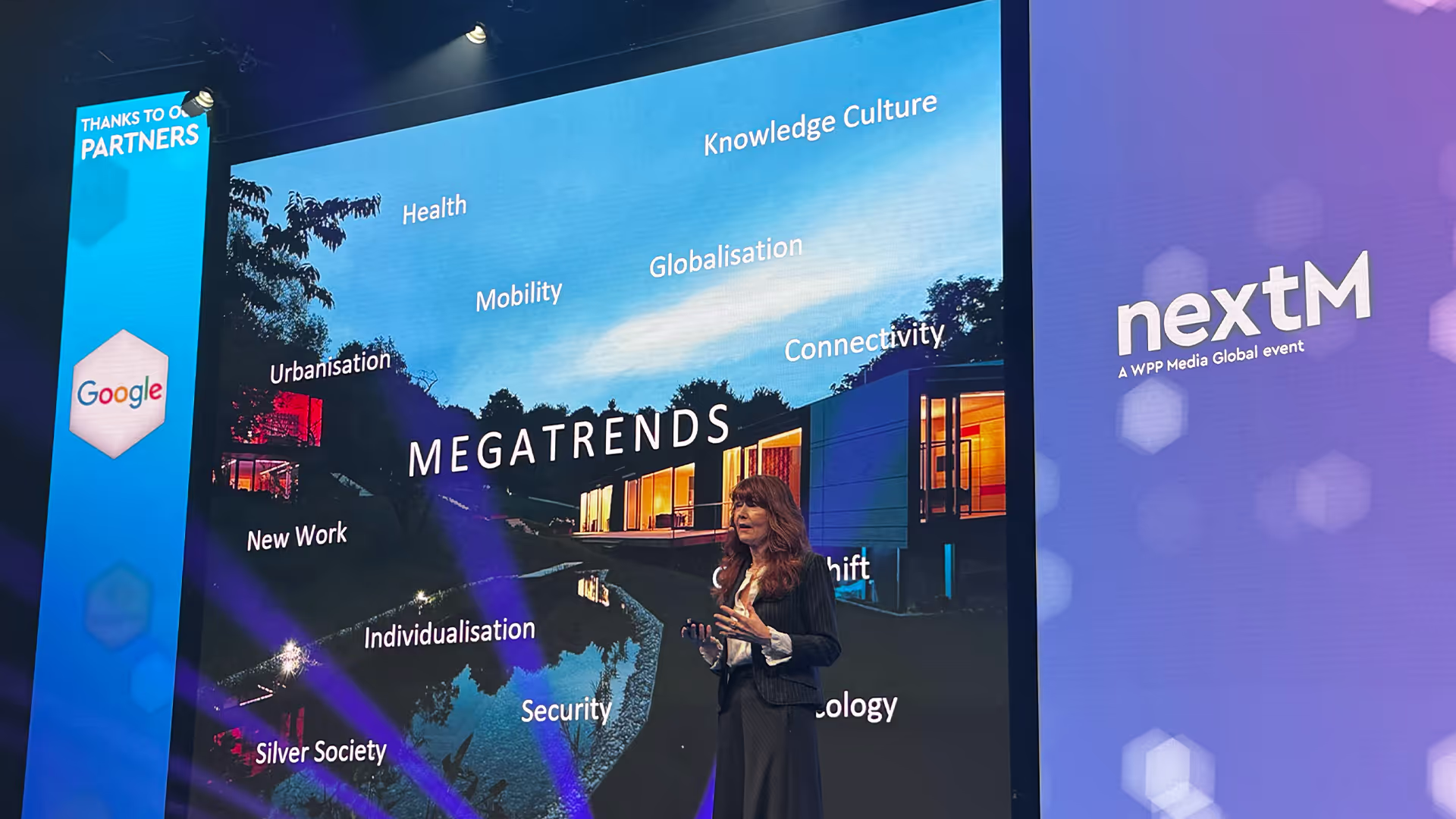
In her keynote, Oona Horx-Strathern spoke about spaces, lifestyles, and societal evolution. For me, however, the most profound takeaway was a broader concept: almost every trend triggers a counter-trend. This mindset is incredibly valuable for marketers, and when applied to AI, its relevance is immediate.
- The more content is automatically generated, the higher the premium on true distinctiveness.
- The more easily text, images, and video can be scaled, the more vital origin, stance, and precision become.
- The cheaper content becomes to produce, the more valuable unique, non-interchangeable work becomes.
The real bottleneck, therefore, isn't AI-generated output. It is the flawed assumption that more output automatically equals more impact.
Markets react to oversupply, and so do digital platforms—if not always explicitly, then always economically. When content becomes generic, its perceived value plummets. And when perceived value drops, economic return inevitably follows.
Every leap in efficiency ultimately creates a new scarcity. Right now, that scarcity isn't content production. It's credibility.
2. Platform Logic Trumps Production Budget
Roland Eisenbrand's masterclass drove home a critical point: production is no longer the bottleneck. It's not about the tools; it's about the logic of visibility. Content has become infrastructure.
We are seeing this play out in real time. Tools like HeyGen allow us to scale videos in minutes that would have required massive production budgets just a short while ago. Today, the competitive edge belongs to brands that understand how platforms categorize and distribute content. Two examples from the presentation illustrate this perfectly:
- YouTube is increasingly merging into search and retrieval logic. Users aren't just consuming content; they are actively using it as a primary source for answers. Brands that are absent from this ecosystem don't just miss out on the feed—they miss out on the entire decision-making process.
- Platform-native formats, like LinkedIn articles, may not replace your own website, but they vastly increase the likelihood of your brand being semantically mapped across different contexts.
This is where the paradigm shift lies. Visibility used to be a matter of rankings and reach. Today, it is a matter of categorization.
Google describes its AI Overviews as search experiences designed to summarize answers, handle follow-up queries, and reformat web information on the fly. Because Large Language Models (LLMs) generate probabilities rather than absolute truth, they dictate which brand appears as the most contextually relevant answer.
For brands, the implications are clear: being visible is no longer enough. What matters is how you are understood. The bottleneck isn't the content itself; it is your brand's ability to be clearly interpretable by these systems. Consequently, our measurement logic must evolve.
Today, your brand doesn't just exist in the minds of your customers, it exists in the training models of search engines and AI. That is where topic authority is decided, and where it is determined whether you even surface as a relevant answer. Legacy KPIs like traditional rankings and raw reach simply no longer suffice.
The crucial questions we must ask are:
- Which topics are inextricably linked to your brand?
- Which ones are completely missing?
- And which territories are your competitors already occupying?
This is precisely why we at hurra.com have begun systematically mapping this new layer of brand perception.
With Brandities, we translate this semantic logic into a concrete, actionable model. Think of it as a semantic "city map" that reveals exactly how AI systems categorize your brand—showing which topics sit at your core, which are too far removed, and where the critical gaps lie.
If you want to see this shift in action, you can explore your own brand's map here: brandities.hurra.tech
Ultimately, this fundamentally reframes the core marketing challenge. The question is no longer, "How much content can we produce?" It is, "Are we even being properly understood by the systems that matter?"
3. We often measure impact where it becomes visible – not where it originates
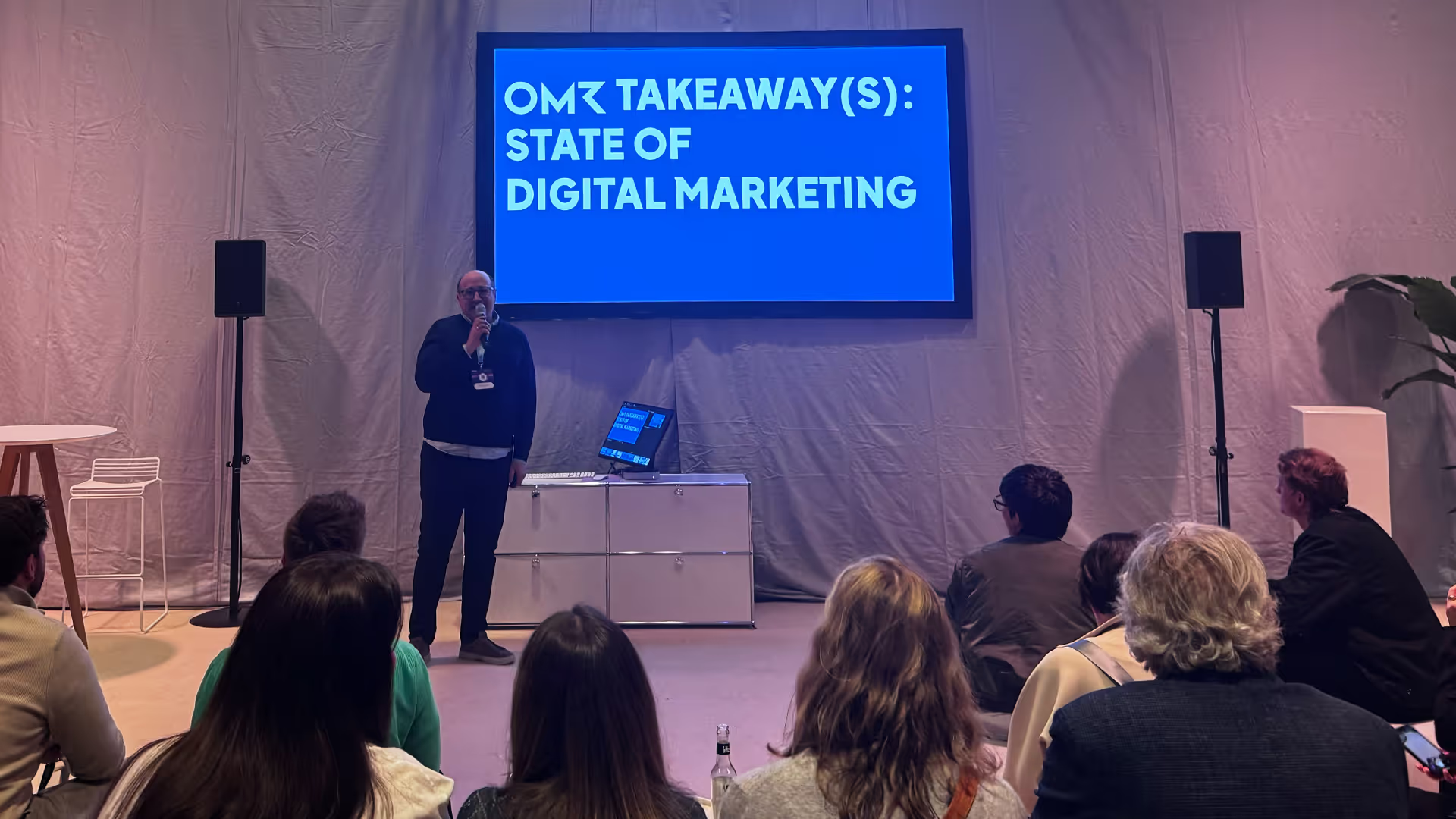
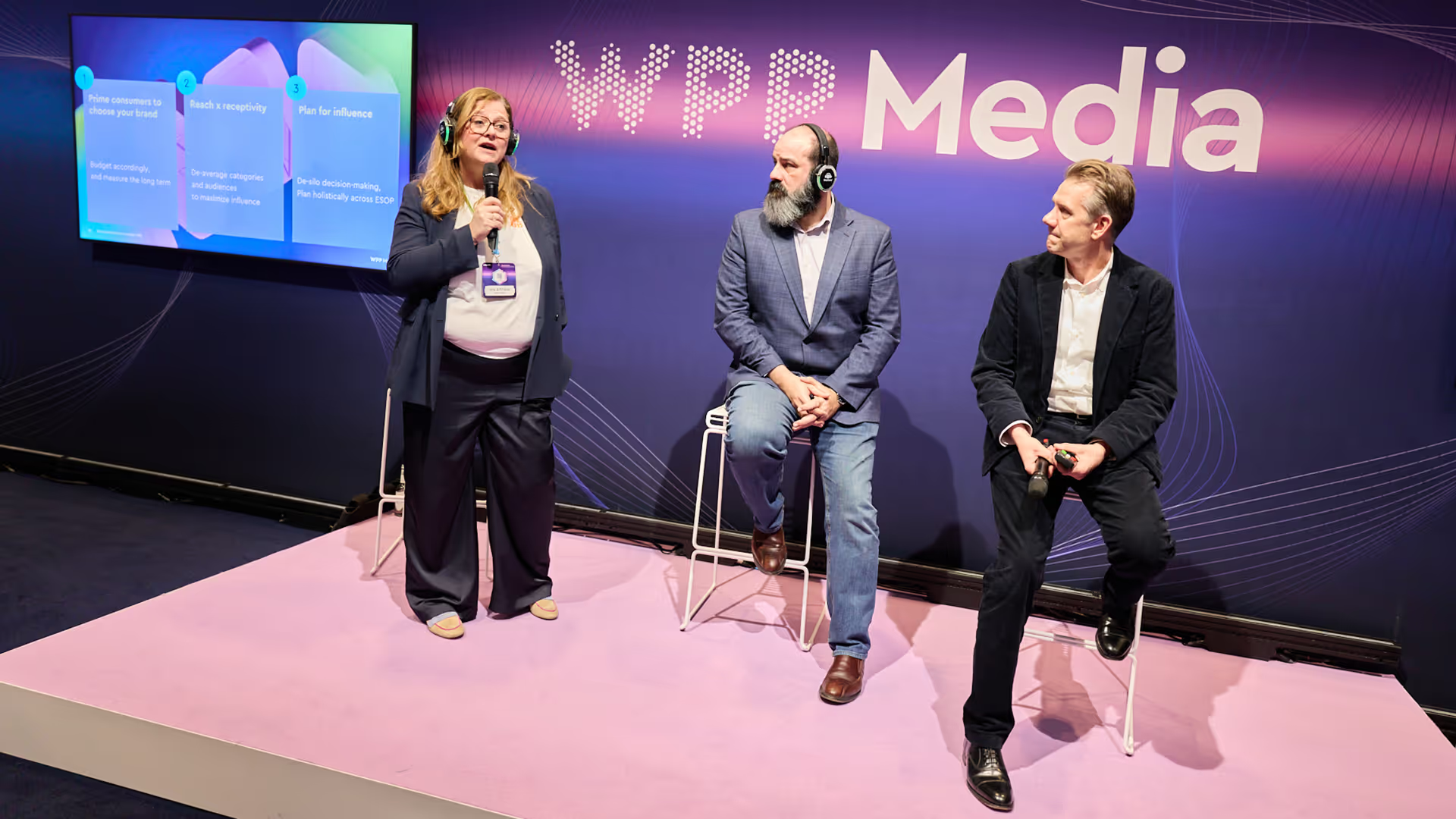
In terms of pure substance, the most critical presentation for me was "How Humans Decide: Rethinking Media Effectiveness" by Felipe Thomaz, Iris Althaus, and Stuart Bowden.
As an industry, we consistently measure impact where it surfaces, rather than where it begins.
- The click is visible.
- The purchase is visible.
- The conversion is visible.
But visibility should never be confused with causation.
The underlying WPP/Oxford study "How Humans Decide" is based on 1.2 million purchase journeys. Its most profound finding? On average, 84% of purchases are attributed to brands for which consumers already had an existing inclination or predisposition before entering the active buying cycle.
This doesn't mean performance marketing is unimportant. It simply means that performance marketing operates on a field that has already been paved.
The real limitation, therefore, doesn't lie with performance marketing itself. It lies in an overly narrow model of demand. If you only optimize for clicks and conversions, you are measuring reaction—not impact.
Reach is a prerequisite, but reach alone is not an impact model.
Ultimately, the crucial question is no longer just, "Did we reach them?"
The defining question is, "Did we reach them within the right context, leaving the right lasting impression?"
4. Stories are not an add-on – they are memory infrastructure
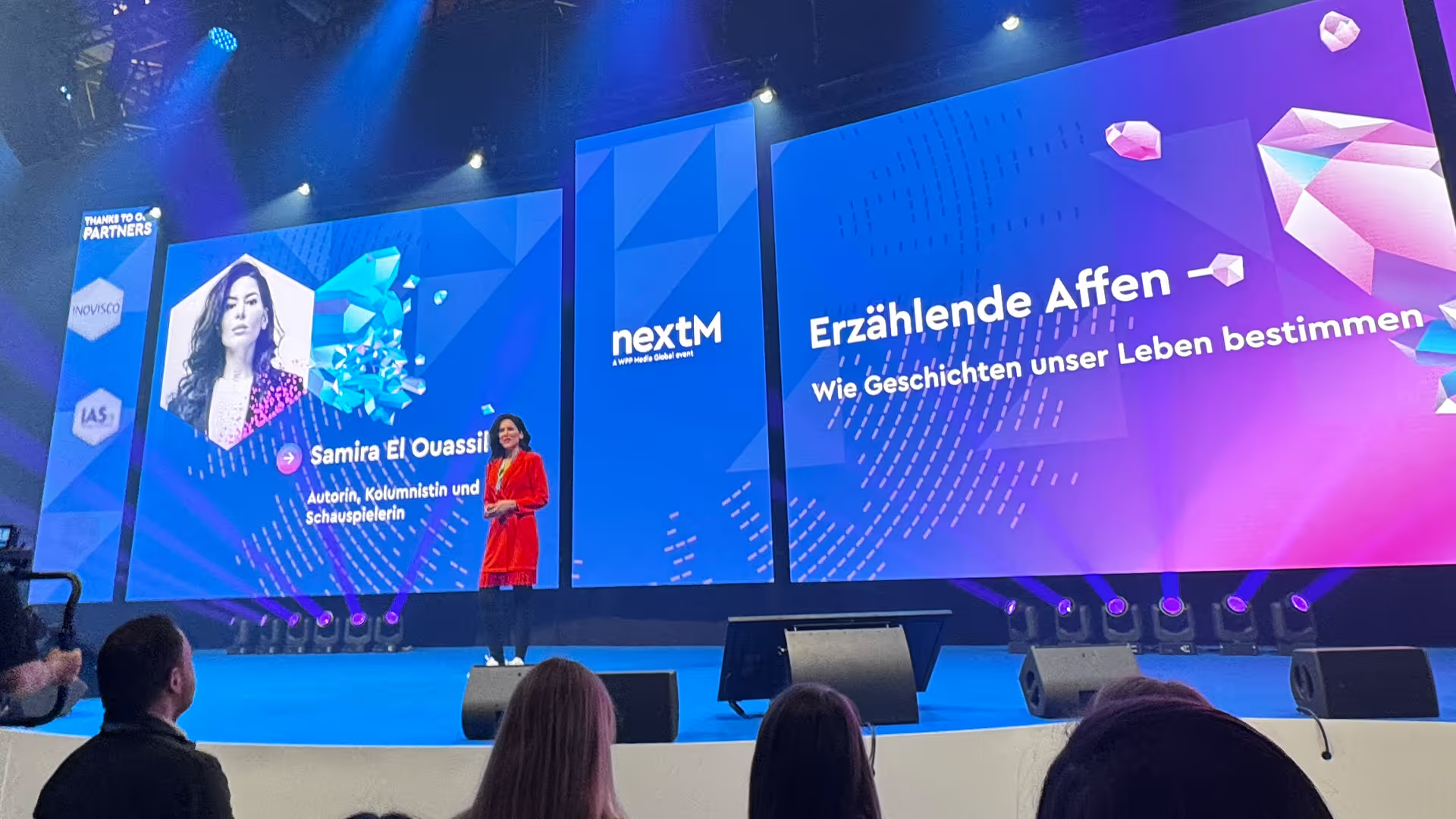
In my view, Samira El Ouassil delivered the most powerful keynote of the day. Her core message was clear: stories are not a cultural garnish. They are the central system through which humans process, retain, and transmit meaning.
For brands, this isn't a "soft" creative topic. It is a hard economic reality.
Stories are far more than just the pretty packaging of a corporate message. They form the cognitive framework through which value is created, stored, and passed on—a reality that is routinely underestimated in modern marketing.
A massive portion of today’s advertising is built on the flawed assumption that attention automatically translates to impact. That is incredibly short-sighted. Attention is merely the entry point. True equity is only generated when a message is not just seen, but categorized, remembered, and retold.
This is exactly why her Villarriba and Villabajo example was so spot-on. Decades later, people still vividly remember those two rival dishwashing villages. That longevity wasn't bought by raw media pressure alone; it was earned because it was anchored in a simple, clear, and universally recognizable narrative archetype.
The real divide in our industry, therefore, isn't between brand and performance marketing. It lies between performance that leaves a lasting impression, and performance that is instantly forgotten.
Mastering the art of storytelling means understanding more than just an extended chain of impact. It means understanding how humans naturally reduce complexity, map cause and effect, and assign meaning to their buying decisions.
Because of this power, narratives are never neutral. They can build profound trust, offer clear guidance, and drive customer preference—but they can also oversimplify, distort, and breed false certainties.
If the vast majority of consumer purchases rely on pre-existing brand imprinting, then how we build that imprint is no longer a peripheral creative issue. Narrative ceases to be an afterthought; it becomes a core pillar of a brand’s economic infrastructure.
5. The real challenge is a management challenge
The ultimate common denominator of these presentations isn't a marketing issue at all. It is a management issue.
When organizations over-index on short-term, visible metrics, they inadvertently shift budgets into areas that are seemingly efficient, but not necessarily effective. This creates a dangerous illusion of security.
Digital platforms provide clear signals, but clear signals are not a complete explanation of business impact. Our measurement methods are merely models of reality. They are maps, not the terrain.
This is precisely where the structural flaw in most dashboards becomes apparent: they are built around platform reporting logic rather than the economic logic of the customer. The starting point is too often, "What metrics do we have available?" when the vital question should be, "What ultimate business outcome are we trying to achieve?"
We need to reverse-engineer our dashboards from the desired business outcome. We shouldn't start with clicks, reach, or platform ROAS, but with the specific incremental value we intend to generate—whether that is healthier contribution margins, higher-quality demand, or more profitable long-term growth.
Only then can we deduce which signals truly matter. Doing anything else simply produces flawless reporting for a closed system that does nothing but validate its own logic.
In practice, we see this exact "false precision" every day. Campaigns look pristinely optimized inside the ad manager, while the underlying quality of demand or the actual contribution margin is quietly deteriorating.
This is exactly where performance marketing must be rethought: not as channel optimization, but as a framework for decision-making under uncertainty.
This philosophy is the foundation of everything we do at hurra.com. Through hurra.ai, our focus is entirely on elevating decision quality.
With OWAPro™ we build a more reliable map of marketing impact from fragmented, uncertain signals—integrating consent management, first-party tracking, and cost data all the way through to advanced attribution, MMM, and geo-testing. With Ads Defender™, we detect fraudulent click signals in real time, keeping them out of the media ecosystem before they distort automated bidding algorithms, pollute remarketing lists, and misallocate budgets. This is precisely where false precision begins—looking clean in the dashboard while quietly draining operational capital.
This isn't just a product pitch; it is the logical consequence of a single, undeniable observation:
Real impact happens between channels, before the click, and far outside of what platforms choose to make visible. Tomorrow, take a hard look at your most critical dashboard and ask: "Is it measuring real impact, or just movement?"