

A few weeks ago I watched a video of Mark Zuckerberg that I can't get out of my head anymore. His vision: Meta takes over the entire ad flow. Enter your credit card, define conversions — the rest is automatic.
This direction is logical. Platforms such as Meta, Google or TikTok have the biggest data advantage. They know every interaction, every click, every conversion — and can link this data to ad delivery and even AI-powered creatives in real time.
We can already see the precursors:
- Google PMax is already largely fully automated today — a black box system that you feed and which you then have to trust. By default, brand keywords are included. You can exclude them now, but whether brand traffic never actually slips through remains a question of trust in the end. This is exactly what the basic problem of black box systems shows: You give up control and have to trust platforms. But at the same time, I understand why platforms go this way: Too much manual targeting often results in over-optimization, destroys learning phases and limits performance. Automation forces campaigns to run more broadly — and that can improve brand performance.
- TikTok shows where the journey is heading: Your algorithm is probably the strongest currently available because it pulls users into a dopamine spiral every day. This mechanism can be transferred 1:1 to ads — just a matter of time.
It sounds perfect in terms of idea: no more manual setup, no more pushing budgets or target groups for hours. Everything runs by itself.
But: It also feels a bit like a slot machine in Las Vegas. Profits are possible, but control over how campaigns actually optimize is gradually lost.
We are already seeing:
- Creatives: AI can create texts, images, and videos in seconds.
- Bidding & budget: Google PMax or Meta Advantage+ are largely fully automated.
- Targeting: More and more adjustments are disappearing — the black box is growing.
And yet: AI is reaching its limits. Really creative ideas and authentic campaigns They are not created automatically. An AI scales content, but it doesn't create real “moments” that surprise, touch, are relevant.
An example: H&M campaigns convey a sense of life. Today, I often see products that don't appeal to me personally. The vision would be for AI to show me exactly the product line that suits me — and that embedded in the human-developed campaign idea.
We can already see a real example at netflix: There, AI decides which thumbnail I see in order to maximize my likelihood of clicking. But the show idea itself remains human.
I believe that 70-80% can be automated. But the Campaign ideas must come from people.

One of the most dangerous points: AI optimizes perfectly — but only for what you tell it to do.
When an advertiser optimizes for ROAS alone, it often ends in the Paid media trap: efficient in the short term, but not profitable in the long term.
Because what happens if a product A is advertised unprofitably, but leads to customers buying additional products from Category B? The AI only understands these connections if we explicitly replay them.
More importantly: AI is only as good as the signals it receives.
Apple is continuously tightening the rules with Safari: Tracking parameters such as gclid or fbclid are already being blocked today. In practice, many marketers report that even Google Tag Manager no longer loads reliably under strict Safari settings. The platforms are working on workarounds — such as obfuscated parameters or server-side tracking. But it remains a game of cat and mouse.
My observation: The question is rarely whether AI “optimizes better” than a human — it almost always does. The real lever lies in Which KPIs we set and how business logic flows into the system.

Meta, Google, Amazon, TikTok, Microsoft — everyone builds their own Walled Garden. Everyone wants the entire budget — but everyone is pursuing their own goals.
Historically, the majority of budgets flowed google And finally strong to meta. But the world is changing:
- Brand searches are losing importance because more and more direct answers come from AI assistants such as ChatGPT.
- amazon Wins massively because buying intent can be directly measured here.
This means that media budgets must be redistributed. And this is exactly where the complexity comes from:
- Platforms provide fragmented figures.
- Each publisher optimizes for their own truth.
- Budgets must be orchestrated across platforms.
This is exactly where we go with our business intelligence solution OwaPro™ on. We bundle all data — including costs — in a central Single Source of Truth. About hurra.ai can this data be linked to LLMs and complex questions can be answered immediately. Things that only data science teams could do in the past are now available in seconds. And that is exactly what is crucial for making fact-based budget decisions across platforms.
It's clear to me: Agencies & experts will remain in demand in the future. Because the question is not whether campaigns run efficiently in Meta or Google — but How to allocate budgets across all platforms to achieve the highest ROI.
A good two and a half years ago, when the first paid versions of ChatGPT went live, we immediately introduced the tool to the agency. The effect was noticeable: E-mails could be answered more quickly and texts could be created more efficiently. But at the same time, we also saw the downside: As soon as the famous “—” appeared in the text, we knew that ChatGPT was at work here. Efficiency yes — but personality was missing.
And the big leap in productivity? To be honest, I haven't seen him yet. Because time saved by sending an email quickly goes into a coffee break or chatting with colleagues.
That is exactly why we are addressing the question today: How do we really transform ourselves into an AI First Agency? Our goal is that time savings and productivity do not fizzle out on autopilot, but reach the customer directly — in the form of added value, speed and better results.
To do this, we started around two years ago, with hurra.ai to bundle our entire marketing and performance knowledge from 20 years and to make it available to all employees 24/7. Today, the system often recognizes complex relationships better than anyone — and at the same time reduces internal communication for repetitive tasks.
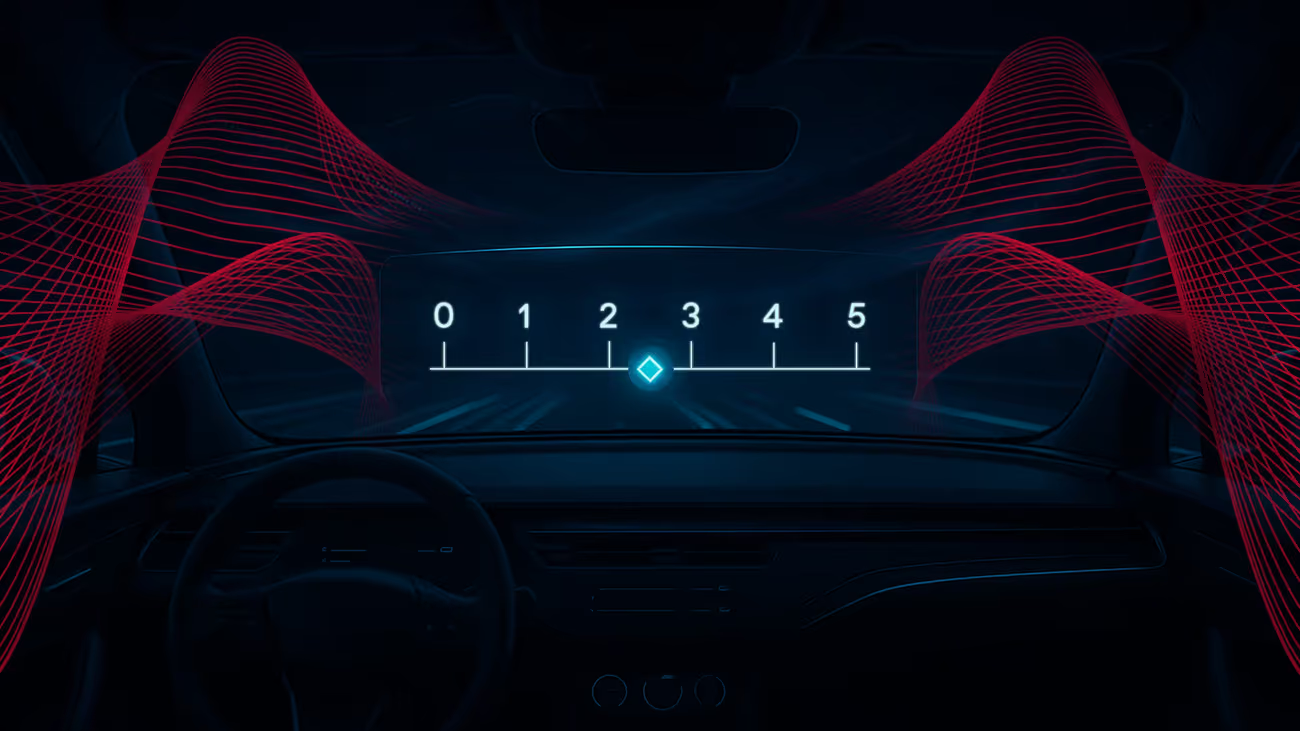
We've divided our roadmap into five levels — inspired by Tesla's self-driving cars. We are currently at levels 2-3: The system can “park in and out”, i.e. perform tasks automatically and recognize patterns.
We're not yet where we want to be in the long term. But it is already helping us enormously today to best common AI systems such as Claude, ChatGPT, Gemini or DALL·E to orchestrate in such a way that our team uses the right AI for every single task — and not just ChatGPT as a matter of principle.
It is just as important to make use of information from different sources. Until recently, we still had to Drive, Confluence, Slack, HubSpot and search for other tools in parallel. Today, we have pooled this knowledge. It is a huge relief when you no longer spend time searching but get answers straight away.
And the same applies to team collaboration: Instead of tearing colleagues out of their flow due to minor problems, everyone can directly access the bundled knowledge. This not only saves time, but also keeps everyone focused.
We are not yet fully autonomous, i.e. “Agent AI at the push of a button”. And that's a good thing. Because it shows: People remain in demand. Only the ways of working are changing radically. The real challenge lies less in technology than in ourselves: in our habits.
Today, every employee has the opportunity to Expert level to advise — something that used to be impossible because no one could get deep into all topics at the same time. With hurra.ai Everyone immediately knows who in the company can help with a topic and what is best practice. More data = more know-how = more expert output.
I'm extremely bullish what hurra.ai concerns. For us, it is no longer an experiment, but a real game changer on the way to AI First Agency
If you want to try out this topic yourself: We currently have a free DMEXCO offer for hurra.ai, which is available until the end of the year. This way: hurra.ai/dmexco-offer
Conclusion
Zuckerberg's vision of total automation is logical — and it is coming. But AI is not the end of our work, but the beginning of a new phase.
- AI performs many operational tasks.
- People remain in demand for story, strategy and KPI logic.
- Agencies & experts remain relevant because budgets must be distributed between platforms.
- The biggest challenge is not in technology — but in ourselves, in our habits.
AI does our job — but not the responsibility.